

Imagine a trader asking an AI agent to find a good opportunity in EUR/USD, check the market conditions, and place a trade when the right price comes along. The agent analyses the charts, weighs the risks, and executes the order based on the instructions it has been given. The trader may not even need to open the trading platform. Now take this a step further. What if the same AI agent also decides which broker to use?
Are marketing agencies still telling you to create content for humans? Maybe they’re now telling you about AEO, optimizing your content to feature on LLMs. Time to rethink your strategy. Soon, the one choosing your brokerage won’t be a person scrolling your homepage. It will be an AI agent working through a checklist.
The Choosing Has Begun
Traders are already handing the broker check to AI. The most common prompt is “Is [broker] a scam?” It adds that AI answers lean on regulatory status, longevity, awards and transparent fee and risk disclosure. In fact, a 2026 Investing.com survey of 938 US retail investors found 62% use AI to inform their investment decisions. And when Google shows an AI summary, users click a regular result in only 8% of visits, against 15% without one. Your carefully built landing page is being skipped.
But agentic AI takes this further. Unlike a conventional chatbot that provides information, an AI agent can work towards a specific goal. It can research options, compare products, interact with other systems, and carry out tasks within the permissions it receives.
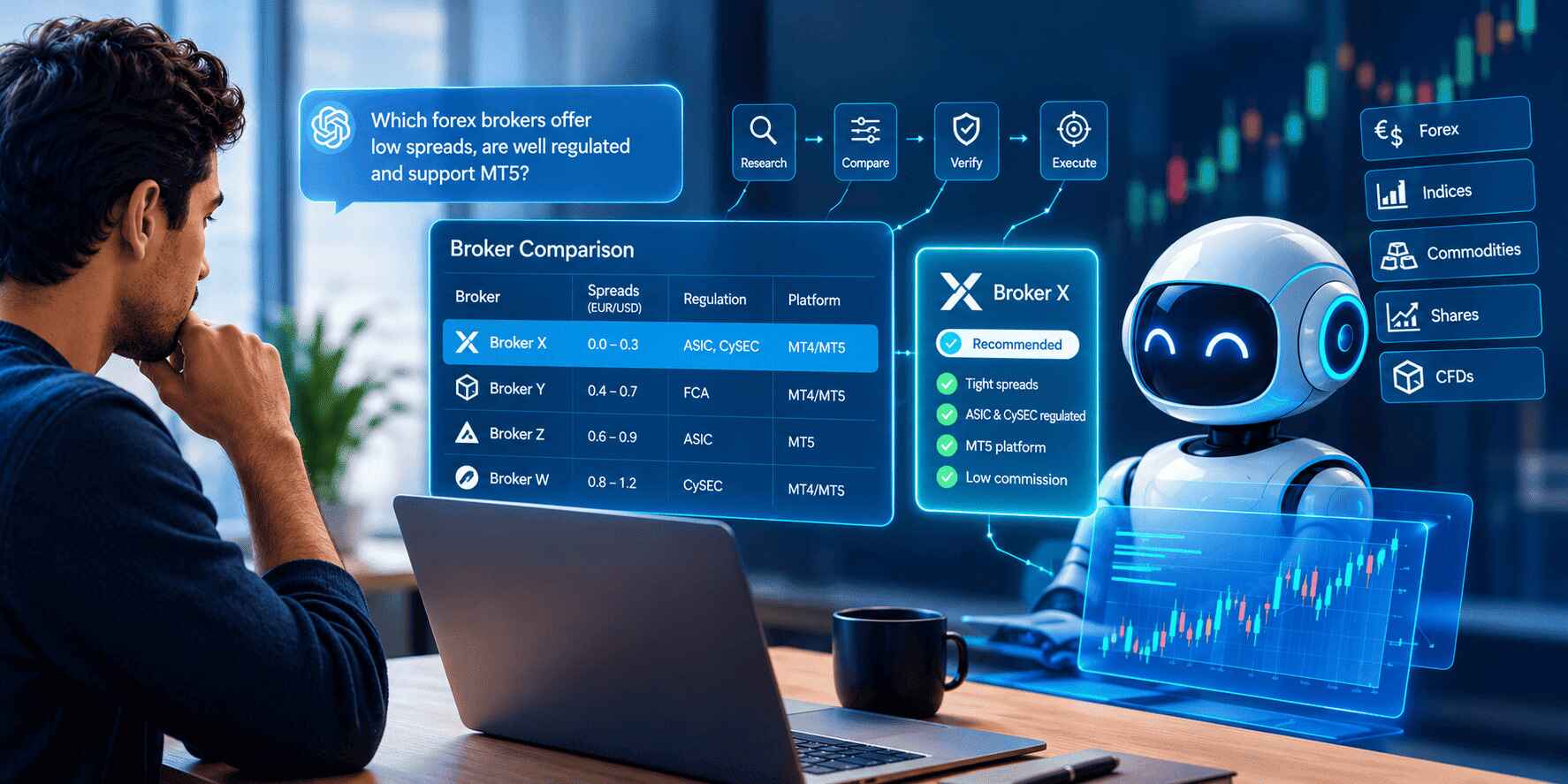
In the world of retail trading, this could mean an agent assessing a trader’s requirements and independently evaluating which brokers meet them. For example, a trader might instruct an agent to find a broker that offers:
- Regulation from a recognized financial authority
- Competitive spreads on major forex pairs
- Access to MT4 or MT5
- Suitable leverage and margin requirements
- Transparent commissions and overnight financing charges
The agent could compare these factors across multiple brokers, eliminate those that don’t meet the requirements, and present a shortlist. Eventually, it may be able to complete more of the process, including account onboarding and trade execution, subject to authorization, and regulatory requirements.
So, marketing is no longer just about getting your name into an AI-generated answer. It is about making sure the brokerage is understood, evaluated and selected by an AI agent.
Agentic Trading Makes AI the Decision Maker
Agentic trading means an AI agent researches, compares, and eventually trades for the client. That makes the choice of broker a machine decision. The agent will shortlist, rule out, and recommend. A human may still press the final button, but only on brokers the agent let through. Gartner found only 11% of US consumers would let AI make purchases outright. About 28%-31% would let it narrow their choices. Narrowing is the part that decides who gets considered.
Forbes has already predicted this shift. cTrader launched MCP servers in May 2026 so agents can manage positions. Capital.com followed in MENA, with a two-step confirmation before trades. The infrastructure is evolving fast. The next wave is agents completing whole transactions inside the chat, and brands will need their own layer to speak for them there.
An Agent Doesn’t Read Your Copy. It Checks Your Facts.
Research by the FCA found that one in five UK adults, equivalent to approximately 11 million people, would be likely to use AI capable of acting autonomously within preset goals. These findings suggest that financial services are moving towards a more automated decision-making environment.
The opportunity is there for those willing to move early. Rather than jumping on the bandwagon when agentic trading becomes mainstream, brokers should start preparing their marketing strategies now.
A human can be charmed. An agent can’t. It weighs spreads, fees, licenses, execution quality, and platform support, then cross-checks them. Marketing built on persuasion, mood and adjectives gives it nothing to work with. So:
Publish Your Data for Machines
Spreads, commissions, swap rates, margin requirements, instruments, platforms and regulatory status belong in clean, structured, regularly updated pages and feeds. An agent comparing brokers will favor the ones it can verify fast. Don’t hide important information in lengthy PDFs or promotional copy. Instead, use structured tables, clearly labelled pages and accessible data feeds or APIs wherever appropriate. The objective is simple: an AI agent should be able to retrieve the information it needs without having to interpret vague marketing language or search through multiple pages.
Replace Persuasion with Proof
Every claim should be specific, current, and sourced. Cut out “best” and “lowest.” An agent can’t verify them, so they count for nothing. For example, instead of claiming to offer the lowest spreads, publish the actual spread information, explain whether it is fixed or variable, and state the conditions under which it applies. Instead of describing the business as a leading regulated broker, identify the regulator, license number, and relevant legal entity. In short, move from persuasion to verifiability. The more specific and transparent the information, the easier it becomes for an AI agent to assess the offering.
Keep One Source of Truth
AI agents gather information from several sources, not just your website. They could cross-check regulatory registers, financial publications, comparison websites, review platforms, app store listings, and even social media chatter. If you publish one set of trading conditions on your website and different information elsewhere, it creates uncertainty because every inconsistency lowers trust. Your website, directories, review sites and app store listings must agree on pricing, account types, licenses and more.
Make Pages Comparison-Ready
Use tables, FAQs and schema for each account type and market, with “last updated” dates. Build around real customer questions by mining your support chats for them. This is the same work as generative engine optimization (GEO), so it doesn’t need a separate budget.
Build Signals AI Agents Trust
Agents lean on independent evidence, such as regulator registers, reputable reviews, press, and awards. Digital PR and review management now matter more than ever. Focus on earning credible third-party mentions and maintaining accurate profiles across relevant platforms. Publishing more articles on an owned website is not necessarily the answer. The objective is to build an online presence that AI systems can independently verify.
Explain How Agent Access Works
Marketing and technology teams need to start working together. Very soon, brokers will need dedicated interfaces that allow authorized AI agents to access relevant information and interact with their services. This could include APIs that provide real-time or regularly updated trading conditions, account information, and instrument specifications. It could also involve secure integration protocols that allow agents to perform specific tasks, subject to authentication and client permissions. Think beyond making the website easier to read. Make the brokerage easier for an AI system to interact with. Where you allow automated trading, document it plainly, including permissions, confirmations, limits. If an agent can’t understand your terms, it can’t recommend you.
Measure Agent Influence
Traditional marketing metrics such as impressions, website traffic, click-through rates, and last-click conversions will not tell the complete story. A broker could be shortlisted by an AI agent without receiving a website visit. The trader might only arrive when they are ready to open an account. Track traffic from ChatGPT, Gemini, and Perplexity, branded search lift, and sign-up answers to “How did you first hear about us?” Also, remember that prompt-tracking dashboards can mislead, since AI models remember each user. Use them as a guide, not a verdict.
Marketing teams can begin monitoring:
- How frequently does their brokerage appear in AI-generated broker comparisons.
- Whether AI tools accurately describe their products and regulatory status.
- How often their brand is recommended for specific trading requirements.
- Referral traffic from AI platforms
- Changes in branded searches and account registrations originating from AI discovery
The Next Marketing Race Has Already Started
Adding AI features to a trading platform is one thing. Preparing a brokerage for a world in which AI agents research markets, choose brokers, and execute trades is quite another. The real challenge is to become part of an agent’s decision-making process. Can it access your trading conditions? Can it verify your regulatory credentials? Can it compare your execution quality and costs with those of other brokers? And, ultimately, does your offering meet the trader’s requirements?
These are the questions marketing teams need to start thinking about. While traditional SEO, advertising, and brand building will still have a place, they won’t be enough on their own. AI is already choosing brokers. Get ahead of the race by making your content easy for machines to find, read, evaluate, verify, trust, and recommend.
Leave A Comment
You must be logged in to post a comment.